
Dotcom Baron
Genre Power: Why Broader Thinking Beats Narrow Niches for True Business Freedom

Sep
Forget what many marketing guides tell you about niching down. While narrowing your focus can be helpful, there’s another approach that offers a different kind of freedom: thinking in genres.
To be clear, there’s nothing inherently wrong with niching down. It works wonderfully if you’re committed to a specific area for the long haul.
However, at Dotcombaron, our philosophy centers on ultimate control. We believe in building a business that isn’t dictated by external factors – not by networks, platforms, other people, or even a single niche.
By the end of this article, you’ll see a clear mindmap illustrating how all these ideas connect, providing a holistic view of this strategy.
As a true Dotcombaron, you want the freedom to introduce any product you choose, collaborate with any person or company, all without becoming dependent on them.
The goal is to pick what resonates with you and then strategically connect it with an existing audience.
Consider the example of the ‘Shark Tank’ investors. While their capital is significant, their true power lies in their extensive networks and established audiences. When they spot a promising product, their first thought isn’t just about funding, but how to seamlessly integrate it into the audiences they already command. This happens long before any deals are even discussed.
Without a ready audience or a substantial advertising budget, generating momentum can feel impossible. A small ad spend often yields little return, and even with a larger budget, a missing conversion strategy can lead to significant losses, leaving you further behind.
Many turn to established platforms like Amazon, Etsy, or eBay for traffic. While these marketplaces offer reach, they come with fees – listing, handling, and more – and, crucially, they retain ultimate control.
These platforms can close your account at will, gather your valuable customer data, dictate your content, and even restrict your traffic if you step out of line. This raises a critical question:
Are you the entrepreneur truly in control of your destiny, or are you subject to external forces?
Even with an exceptional product, service, or sales skill, if you lack consistent traffic, your potential remains untapped – much like a brilliant mind without an audience to appreciate its wisdom.
Imagine you don’t have a massive advertising budget or a vast social media following, yet you aspire to reach people and share how you can help them.
To achieve this, mastering the art of connecting with cold audiences becomes essential. A wider reach is valuable, especially when you lack the time or budget for extensive ad testing or slow relationship building with existing gatekeepers.
Once you understand how to attract attention, the next step is optimizing conversions. This calls for a blend of persuasive copywriting, strategic planning, and a well-structured approach. While exceptional copywriting is vital, it also requires understanding user experience, offer design, and overall communication strategy.
This brings us back to the power of genres over restrictive niches.
Understanding Genres and Their Business Impact
Why genres? Simply put, genres offer a significantly broader canvas for your work. When you can capture the attention of a cold audience using strategies tailored to a specific genre, you’re on a powerful trajectory.
Think of common genres: fiction, non-fiction, horror, drama, comedy, and so many more.
For years, I’ve deeply immersed myself in scriptwriting and all things related to filmmaking, especially the insights from masters like Michael Hauge. This journey also included countless hours with:
- In-depth actor discussions, like these actors’ roundtables
- Insights from movie critics, such as Film Courage
- Engaging scriptwriting tutorials on YouTube, for example this one
The list is extensive, but these examples highlight the depth of exploration. (Feel free to reach out via WhatsApp if you’d like more recommendations.)
This kind of immersion deeply shapes your communication, refining your instincts on a subconscious level. It’s about internalizing effective patterns until they become second nature – a fascinating subject for a future discussion.
The Unseen Power of the Movie Industry for Business
The movie industry is a masterclass in business strategy, especially in its remarkable ability to connect with vast, diverse audiences across all demographics.
They expertly tap into emotions, translating that connection into ticket sales, merchandise, toys, and much more.
My fascination extends to every facet: casting choices, actor performances, script development, trailer production, and comprehensive movie marketing.
Each element is meticulously structured and executed with surgical precision. A deeper understanding reveals an immense level of strategic design that commands respect.
Crucially, these powerful strategies are adaptable to nearly any industry.
Perhaps most compelling is the psychological approach to writing – the art of crafting narratives that build deep attachments to ‘heroes,’ guiding them through their journeys.
These elements are vital for your business success:
Your client is the hero of their own story. You outline the journey they can take to solve their challenges using your product or service. But first, you must forge that emotional connection.
This connection is built by sharing stories they can relate to, allowing them to envision their current struggles being resolved.
Effective storytelling is the foundation. Strategic outreach places that story before the right eyes, and optimized conversion then translates that engagement into tangible results.
Movie scripts, naturally segmented by genre, skillfully engage broad audiences without forcing a narrow niche. Instead, they classify audiences by their preference for emotional experiences.
They build connections by evoking emotions – laughter (comedy), fear (horror), tears (drama), and so on.
Let’s explore what this means practically and why it matters.
Consider a comedy lover. This audience isn’t confined to a single industry or demographic. A doctor, a plumber, and a CEO might all share a passion for comedy, transcending their professional backgrounds.
They are united by a genre, not a niche.
Developing this skill empowers you with a versatile reach, offering a foundational strength for any business environment.
Are you starting to see the profound implications?
The Connection to Modern Outreach
In today’s digital landscape, the potential for reaching individuals via email or phone has expanded significantly. While the idea of ‘unlimited’ outreach might sound appealing, effective communication requires a sophisticated understanding of engagement, respectful follow-up strategies, and meticulous lead qualification to genuinely get noticed in an inbox. Regulatory frameworks and platform policies mean that thoughtful, permission-based communication is always the most sustainable approach.
For more context on advanced outreach methods, you can explore this related article.
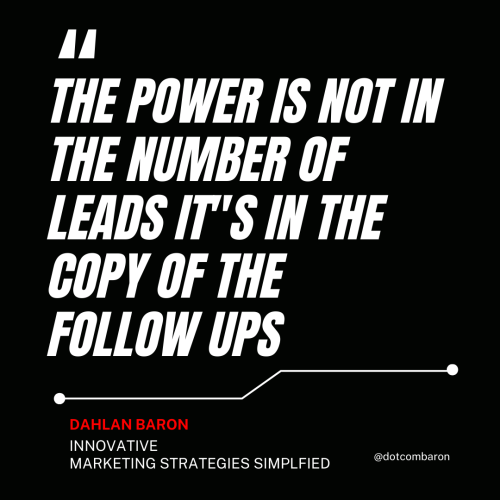
The goal is to capture attention initially, then provide genuine value that addresses their problems, fostering trust. This process requires a nuanced understanding of human interaction.
This is particularly challenging when you’re reaching out cold – via email, WhatsApp, or any message – without an existing relationship.
Think about it: even with potential access to vast traffic, without a clear strategy for engagement, you’re essentially adrift. Traffic alone isn’t enough; knowing how to convert it is key.
Hollywood’s scriptwriting strategies offer profound insights into human psychology, revealing what truly resonates with people and what falls flat. These lessons extend beyond entertainment, impacting how you communicate in any context.
Connecting the Dots: Your Mindmap to Genre-Based Strategy
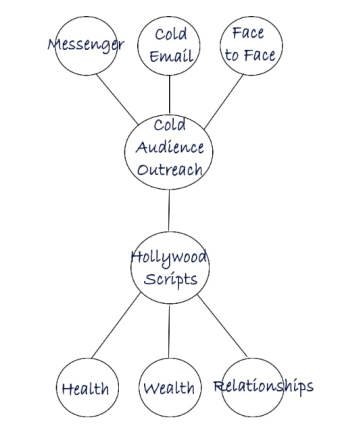
To bring these concepts together, let’s briefly unpack the mindmap below, which illustrates how the elements discussed in this post intertwine.
At the base of the mindmap, you’ll observe broad business industry categories. For clarity, let’s briefly touch on what these encompass.
Within the ‘Wealth’ category, you’d find niches such as real estate, internet marketing, or stock trading. The ‘Health’ category includes fitness, personal training, gyms, and nutrition, for instance.
The pattern is quite clear, isn’t it?
And each of these niches can be further specialized, potentially leading you into that less-contested “blue ocean” space.
Our approach to reaching these audiences involves genre-related content. The goal is to craft messages that spark curiosity and engagement, avoiding anything that might trigger suspicion or skepticism.
The Art of Engaging Communication
Some of our most effective messages are often just a few sentences long. While they might seem simple, they’re packed with emotional resonance and curiosity-driving hooks, compelling people to take the next step.
Understanding these elements clarifies why they are fundamental to crafting powerful outreach strategies, designed to connect with people globally.
Naturally, reaching every single person on the planet is impractical due to time constraints.
And, of course, not everyone is looking for growth or development – but that’s a conversation for another time.
Curious how these insights can be tailored to benefit your specific business and skillset?
We’re currently selecting businesses and products for potential collaborations.
If you’re ready to explore this further, click the button below to schedule a video call.
Final Thought
Considering the strategic power of genre-based communication, how might reshaping your message around universal human experiences rather than narrow industry definitions open entirely new avenues for your business?
Related posts: