
Dotcom Baron
Why Thinking in Genres, Not Niches, Is Your Path to True Business Freedom

Sep
Let’s kick things off with an idea that might go against what you usually hear:
“While other “gurus” will tell you how you need to niche down, I’m focused on genres.”
Now, I’m not here to say that niching down is inherently wrong. Quite the opposite, it can be incredibly effective – but primarily when you’re committed to that specific niche for the long haul.
At Dotcombaron, our philosophy centers on maintaining complete control. We believe in building a business that isn’t dictated by external factors like networks, platforms, individual relationships, or even being permanently tied to a single niche.
Curious how all these pieces fit together? Stick around, because by the end of this post, I’ll reveal a mindmap connecting every element we discuss.
As a Dotcombaron, you want the freedom to integrate any product you choose, partner with any person or company, without ever becoming dependent on them.
The goal is simple: identify what feels like a natural fit and then skillfully connect it with the right audience.
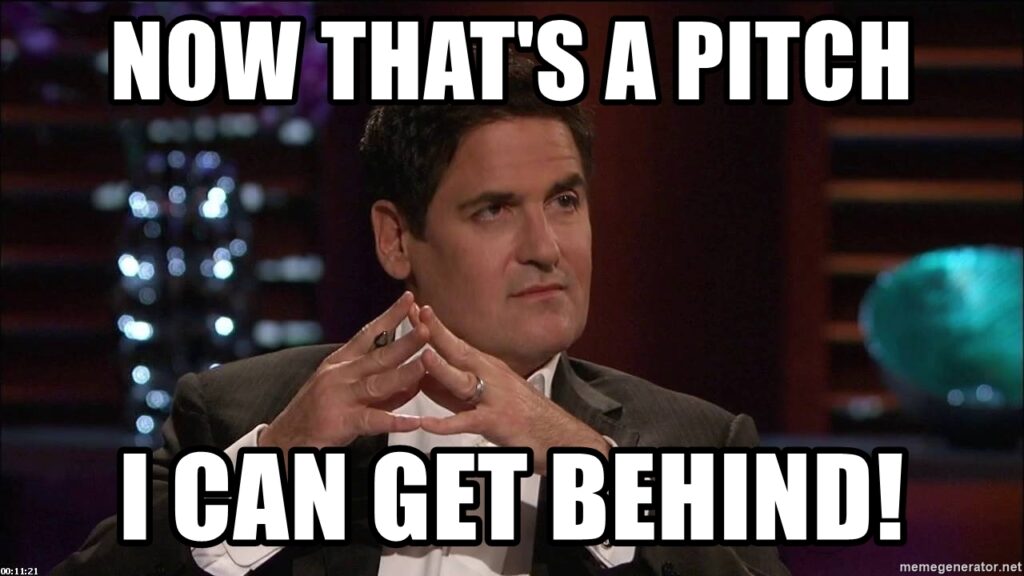
Consider the phenomenon of the Shark Tank series for a powerful illustration. While they certainly bring capital to the table, their true superpower lies in their extensive networks and established audiences.
When they discover a product they like, their first strategic move isn’t about making an offer. It’s about figuring out how to seamlessly plug that product into their existing audience base.
This critical thinking happens long before any deals are even discussed.
What if you don’t command a massive audience, and your advertising budget is modest? Believe me, a fifty-dollar ad campaign isn’t likely to move the needle.
Even worse, if you possess the budget but lack a solid conversion strategy, you risk bleeding thousands of dollars and finding yourself deeper in the red.
This often pushes people towards platforms like Amazon, Etsy, or eBay. They handle the traffic, but you pay for it through various fees – listing, handling, and more. Crucially, they maintain control.
These platforms can close your account at any moment, collect your valuable customer data, dictate your content, and even throttle your store’s traffic if they deem you out of line.
So, are you truly the “entrepreneur” you aspire to be? How much control do you really have in that scenario?
You might have an exceptional product, a stellar service, or advanced sales techniques, but without traffic, you’re like a brilliant history teacher with profound knowledge yet no students willing to pay for his invaluable insights.
Let’s assume you’re operating without a colossal ad budget or a massive social media following, yet you’re determined to reach people and share how you can help them.
The immediate skill to cultivate is learning how to speak to cold audiences. A broader reach is advantageous because you simply don’t have endless time or budget for trial-and-error ad campaigns or painstakingly building relationships with those who already have access.
Once you master traffic generation, the next step is optimizing conversions – and both these skills ultimately funnel into one core competency: compelling copywriting, backed by sound strategy and structure.
And that, in a nutshell, is why we advocate for thinking in genres instead of narrow niches.
What are Genres and Why Do They Matter?
Why genres? Think of genres as significantly larger territories to explore. If you can master the art of capturing a cold audience’s attention using strategies proven effective within a particular genre, you’re on a powerful trajectory.
Just some genre examples: Fiction, non-fiction, horror, drama, comedy…
For years, I’ve immersed myself in the world of scriptwriting and anything related to movies, dissecting every piece of content I could find. My primary mentor, Michael Hauge (often referred to as the G.O.A.T. in this field), has been a huge influence, but I’ve also devoured countless hours of:
- Videos where actors gather to discuss their roles in-depth – for example, the actors roundtable.
- Movie critic videos – like those from Film Courage.
- Scriptwriting YouTube channels – for instance, this one.
I could easily list many more, but for the sake of this post, I’ll stop here. Feel free to reach out via WhatsApp if you’re seriously interested in exploring further.
This deep dive isn’t just about surface-level knowledge; it’s about influencing your writing on a personal, subconscious level. It’s a way of ‘brainwashing’ yourself, not in a negative sense, but to naturally and automatically adopt effective communication patterns – perhaps a fascinating topic for a future discussion.
So Why Movies?
The movie industry, first and foremost, is a master class in what works in business. They’ve perfected the art of reaching diverse audiences, spanning a wide range of demographics.
In other words: they know precisely how to connect with people emotionally, compelling them to buy cinema tickets, merchandise, toys, and so much more.
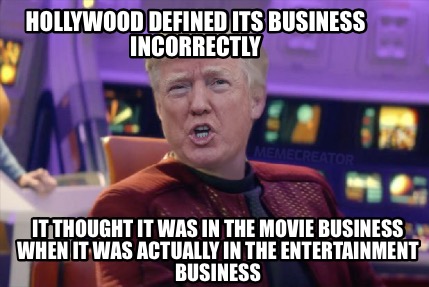
My fascination extends to every single aspect of filmmaking: the casting process, the nuances of actor behavior, the intricate craft of scriptwriting, the creation of captivating movie trailers, and the strategic world of movie marketing.
Each element is so meticulously structured and executed with such precision, that it demands a profound level of respect once you begin to understand it.
Crucially, these incredibly sophisticated strategies are adaptable and can be applied to virtually any industry you can imagine.
But what truly captivates me is the writing itself – the strategy and the psychological approach to crafting narratives. It’s about creating deep attachments to the ‘heroes,’ the main characters, and their compelling journeys.
And these elements are incredibly powerful for your own business:
Imagine your client as the hero. You then describe the transformative journey they can undertake to solve their problems with your product or service. But before that, you need to forge a connection.
You achieve this by sharing stories they can easily relate to, helping them visualize how their current challenges can be overcome.
Storytelling is the foundation. Reaching out effectively places that story in front of them, and skilled conversion turns that engagement into revenue.
Movie scripts, neatly categorized into genres, demonstrate how to speak to vast audiences without forcing a narrow niche. Instead, they categorize audiences by their emotional or thematic preferences.
They build connections by creating powerful emotions – making people laugh with comedy, feel fear with horror, or shed tears with drama.
Let me elaborate on what I mean and why this distinction is so vital.
For example, an audience that adores comedy isn’t limited to a single demographic. It could encompass a wide spectrum of individuals from vastly different industries – a doctor, a local handyman, the CEO of a large corporation – all drawn to the same genre.
Cultivating this ability to connect across diverse groups is a skill that empowers you to thrive in almost any environment or circumstance.
Do you see the profound implications of this approach?
Why is this approach so important now?
Many of us recognize that we live in an era where tools exist that offer incredible potential for reaching individuals via email or phone. The capacity for strategic follow-ups, dynamic message variation, and targeted lead generation is more accessible than ever before.
However, achieving consistent engagement, particularly getting cold, unsolicited messages truly ‘in-boxed’ and acted upon, demands far more than just volume. It requires a deep understanding of human interaction.
If this evolving landscape of outreach and communication strategies is new to you, I highly recommend exploring this post to learn more.
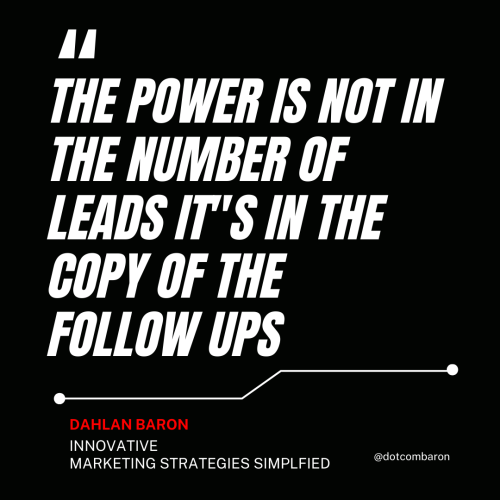
The core challenge remains: how do you capture attention initially? How do you offer something genuinely valuable that addresses their problem, building trust, and prompting them to take a deeper action?
This is especially true when they’ve never heard of you, and your first interaction arrives as a cold email, WhatsApp message, or any other form of communication without a prior connection.
Think about it: you could have all the potential traffic in the world at your fingertips, but if you don’t know what to do with it, you’re essentially running around without direction, right?
This is where Hollywood script strategies become invaluable. They offer profound insights not only into self-understanding but, more critically, into effective communication with other human beings. They teach you what truly makes people ‘tick’ (and what falls flat).
Let’s Take A Look At The Mindmap Below:
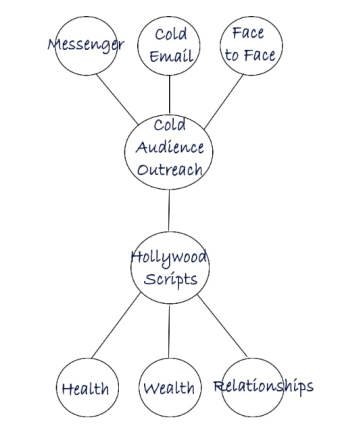
To wrap things up, let’s briefly unpack this mindmap, which visually connects the various elements we’ve discussed throughout this post.
At the bottom of the image, you’ll see broad business categories. If these aren’t immediately familiar, let me offer a quick explanation.
For instance, under the ‘wealth’ category, you’d find specific niches like real estate, internet marketing, or stock trading. In the ‘health’ category, you’d discover niches such as fitness, personal training, gyms, or nutritionists.
You get the general idea, right?
And traditionally, each of these niches could be further broken down, sometimes to the point where you’re metaphorically swimming in a “blue ocean” of highly specific targeting.
However, when it comes to effective outreach, my strategy involves using genre-related content. It’s not just about the genre itself, but crafting content that sparks genuine curiosity without triggering suspicion or skepticism.
That’s really it…
Some of the most effective messages I’ve crafted consist of only two sentences. On the surface, they might appear insignificant, but they are so deeply loaded with emotion and focused on curiosity that recipients want to discover the next step.
So now you understand why these elements are crucial for our strategies – the ones we use to reach out to virtually anyone.
Of course, we won’t literally reach every single person on the planet, simply due to time constraints. Moreover, not everyone is actively seeking growth and development, but that’s a topic for another discussion.
Are you interested in how your business or skill set could benefit from this powerful approach?
I am currently exploring and selecting businesses and products to collaborate with.
Click the button below to schedule a video call and let’s explore the possibilities.
Final Thought
Considering the strategic advantage of genre-based communication, how might reshaping your own audience understanding and messaging approach unlock new levels of reach and genuine connection for your business?
Related posts:
 Only Read This Post If You Like To Grow Your Business | DOTCOMBARON
 The Empathetic Approach to Email List Building: Nurturing Relationships and Boosting Conversion – Part 2 – Includes user case examples!
 Unleashing the Power of Brand Archetypes: A Game-Changing Strategy for Your Brand’s Success
 Unlock More Leads With Content: How Business Owners Can Generate More Quality Traffic
