
Dotcom Baron
The Genre Edge: Shifting from Niches to Unlock Broader Business Influence

Sep
Forget what the mainstream “gurus” tell you about relentlessly “niching down.” Here at Dotcombaron, we’re taking a different path—one focused on the expansive power of genres.
“While other “gurus” will tell you how you need to niche down and I am focused on genres”
Now, don’t get me wrong: niching down certainly has its merits, especially if you’re deeply committed to a specific area for the long haul. But our vision at Dotcombaron is about empowerment and true independence. We believe in building a business where you are in control, unconstrained by the whims of external networks, platforms, people, or even the confines of a single niche.
At the end of this post I will show you a mindmap that connects every element mentioned in this post together
Imagine the freedom: as a Dotcombaron, you have the flexibility to integrate any product, partner with any company, or collaborate with any individual you choose, all without ever becoming dependent. The strategy is simple: identify what resonates, then strategically connect it with an engaged audience.
Consider the titans of “Shark Tank.” While their investment capital is undeniable, their true power lies in their vast networks and pre-existing audiences. When a product catches their eye, their first thought isn’t just about the product itself, but how they can plug it into their existing following – long before any deal is ever discussed.
What if you don’t have that expansive audience or a massive advertising budget? While a small initial investment can kickstart testing, building broad, impactful ad campaigns typically demands more than just fifty dollars to truly move the needle. And even with a substantial budget, without a clear conversion strategy, you risk pouring thousands into a black hole, leaving you further behind than when you started.
This often leads entrepreneurs to rely on major platforms like Amazon, Etsy, or eBay for traffic. While they deliver eyeballs, they come at a significant cost: listing fees, handling fees, and, most critically, your autonomy. These platforms wield absolute control, dictating terms, owning your customer data, managing your content, and even cutting off your sales and traffic if you ever step out of line.
…are you the “entrepreneur” that deserves to be in the position you are? Are you in control of anything?
You might possess the most innovative product, an unparalleled service, or even world-class sales techniques. Yet, without a consistent flow of interested people—without traffic—your brilliance remains largely unrewarded, much like a brilliant but obscure history professor whose profound knowledge never reaches the audience it deserves.
So, if you lack a massive ad budget or a huge social media following but are determined to reach people and share your solution with the world, where do you begin? The answer lies in mastering the art of engaging cold audiences. Broadening your reach becomes paramount because you simply don’t have the luxury of endless trial-and-error with ads or years to cultivate extensive relationships. And once you’ve attracted that traffic, the next crucial step is optimizing conversions—a process where compelling copywriting, underpinned by smart strategy and solid structure, plays a foundational role.
This is precisely why we advocate thinking in genres, not just niches.
What exactly are genres, and why are they so pivotal?
The appeal of genres is their sheer scope. They represent a much larger canvas for your work. If you can master the art of capturing a cold audience’s attention using strategies tailored to a specific genre, you’re on a fast track to widespread influence.
Just some genre examples: Fiction, non-fiction, horror, drama, comedy…
For years, I’ve immersed myself in the world of scriptwriting and cinema, devouring and dissecting every piece of content I could find. My deep dive included the legendary Michael Hauge, alongside countless hours of:
- In-depth actors’ roundtables discussing their craft.
- Insightful movie criticism from channels like Film Courage.
- And countless scriptwriting tutorials on YouTube.
(I could continue endlessly, but let’s save that for another time—though feel free to reach out via WhatsApp if you’re truly curious!)
This intense immersion subtly reshapes your understanding of communication, influencing your writing and decision-making on a subconscious level. It’s about developing an intuitive grasp of what moves people, almost automatically – a fascinating topic we might explore further in a future post.
Why this obsession with movies?
The answer is simple: the movie industry is a masterclass in business. They’ve perfected the art of reaching incredibly diverse audiences, transcending traditional demographics. In essence, they know how to deeply “touch” people emotionally, converting that connection into action—whether it’s buying movie tickets, merchandise, or related products.
My fascination extends to every facet: the casting choices, the nuances of actor behavior, the intricate process of scriptwriting, the magnetic pull of movie trailers, and the strategic precision of film marketing. Each element is meticulously structured and executed with surgical accuracy. Once you begin to grasp these underlying mechanics, you can’t help but develop immense respect – and recognize that these powerful strategies are remarkably adaptable to virtually any industry.
What truly captures my imagination, however, is the storytelling itself—the strategic, psychological method of writing that forges deep attachments to “heroes,” their struggles, and their journeys. And here’s why this matters immensely for your business: your client is the hero of their own story. Your product or service offers them a path, a journey, to overcome their challenges. But first, you must connect with them, making them feel seen. This is achieved by weaving narratives they can instantly relate to, stories that show their current struggles can indeed be resolved.
Storytelling is your ultimate key. Effective outreach puts that story directly in front of your ideal audience, and compelling conversion brings in the revenue. Movie scripts, skillfully categorized by genre, demonstrate how to engage a vast audience without hyper-niching. Instead, they classify audiences by their emotional responses and preferences, building profound connections by eliciting laughter (comedy), fear (horror), tears (drama), and so much more.
Let’s clarify this crucial distinction. An audience drawn to, say, the comedy genre, isn’t limited by occupation or social status. It could encompass a busy doctor, a skilled local handyman, and the CEO of a major corporation – all united by their shared appreciation for humor. Mastering this ability to connect with diverse individuals through genre-based appeal is an invaluable skill, one that empowers you to thrive in any market or circumstance. Can you see the powerful implications this holds for your business?
Why is this concept so vital right now?
Many of you are aware that we now possess unprecedented capabilities for direct outreach, allowing us to connect with a vast number of individuals via email or phone. The potential for intelligent follow-ups, dynamic message personalization (spintax), and the systematic gathering and verification of leads is more robust than ever. Yes, even getting messages reliably “in-boxed” is achievable with the right strategies.
Curious about these developments? Click here to delve deeper into the origins of this powerful approach.
The critical path involves first capturing their attention, then offering genuine value that addresses a problem, thereby building trust. This subtle dance of engagement requires a profound understanding of human interaction, especially when your initial contact is a “cold” email, WhatsApp message, or any form of outreach without a prior connection.
Think about it: you could have an endless stream of traffic at your disposal, but if you don’t know how to convert it, you’re essentially aimless. The strategies embedded in Hollywood scripts offer profound insights, not just into human psychology but into effective communication itself, revealing what truly resonates with people (and what falls flat).
Now, let’s bring it all together with a visual: Take a moment to examine the Mindmap below.
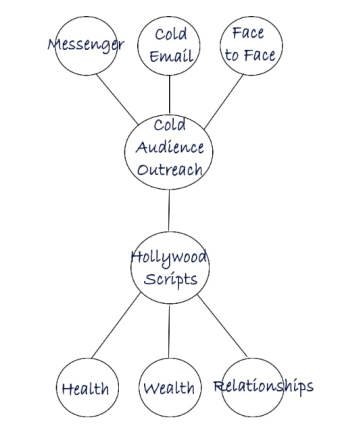
To conclude, let’s unpack this mindmap, which visually clarifies how all the elements we’ve discussed are interconnected. At the base, you’ll observe broad business categories. For instance, under “Wealth,” you’d find niches like real estate, internet marketing, or stock trading. In the “Health” category, you’d see fitness, personal training, gyms, or nutritionists. You grasp the concept, right? Each of these niches can, of course, be further refined, leading you deeper into that coveted “blue ocean” of untapped potential.
The key to reaching these audiences, even within their specific niches, lies in crafting genre-related content. But it’s more than just that; the content must spark genuine curiosity, inviting engagement without triggering suspicion or skepticism.
The Core Principle Revealed
Some of our most successful messages are just two concise sentences. On the surface, they might appear insignificant, but they are so rich in emotional resonance and curiosity-driven hooks that recipients eagerly pursue the next step. You now understand why these foundational elements are crucial to the outreach strategies we employ, allowing us to connect with a truly global audience (though, realistically, time constraints and the fact that not everyone is driven by growth mean we won’t literally reach every single person – another topic for another day!). Are you curious how these principles could profoundly benefit your business and elevate your skill set? We’re actively seeking to collaborate with businesses and product creators who align with this vision.
If you’re ready to explore this further, schedule a video call with us today.
Final Thought
What systems or strategies are currently shaping your business’s future, and are they truly setting you free?
Related posts: